
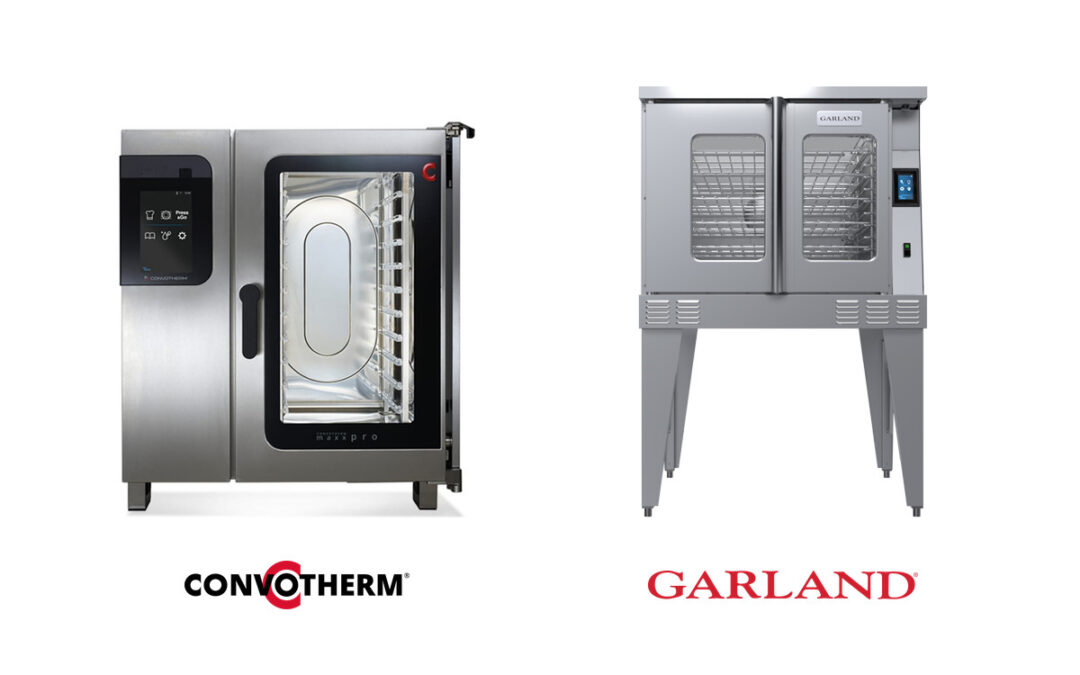


Ask operators what they need from a new oven and you’ll often hear “just more oven.” But the choice between a combi oven and a convection oven shapes your menu, your labor and your floor plan for years. Both use a fan to move hot air, and from across the kitchen they can look a lot alike. What they can do once the door closes is very different.
The problem: two ovens that look alike but work very differently
A convection oven cooks with dry heat. A fan circulates hot air through the cavity so food cooks and browns evenly. It’s the workhorse for baking, roasting and sheet-pan items.
A combi oven does that, too, and adds steam. It can cook with steam alone, with hot air alone, or with a combination of the two while controlling the humidity in the cavity.
That difference is easy to describe and harder to weigh. A combi is generally the bigger investment and needs a water supply and a drain. A convection oven is simpler to install and run. So the real question isn’t which oven is better. It’s which one fits your menu, your space and your team.
Why it matters: you’ll live with this decision every service
Buy more oven than you need and you’ve tied up budget and training time in features nobody uses. Buy less and your team works around the gap with extra equipment, more pans moving between stations and more room for inconsistency. Either way, the cost shows up every service, not just on the invoice.
How Convotherm and Garland help

Convotherm and Garland are both Welbilt brands, and they’re two good answers to two different needs.
Convotherm: when one oven needs to do the work of several. Convotherm’s maxx pro combi ovens are built around what Convotherm calls its Advanced Closed System+ (ACS+). Based on Convotherm’s published information:
- Three cooking modes: steam (86–266°F), combi-steam (86–482°F) with automatic humidity adjustment, and hot air (86–482°F).
- Climate control: HumidityPro with 5 humidity settings, Crisp&Tasty with 5 moisture-removal settings, and a fan with 5 speed settings.
- Two ways to run it: easyDial, where every function is set on one level, or easyTouch, a 10″ touch display with Press&Go automatic cooking profiles.
- Rethermalization built in for bringing prepared food back to serving temperature.
- ConvoClean fully automatic cleaning, with eco, regular and express modes.
- A range of sizes: tabletop 6.10, 6.20, 10.10 and 10.20 models, plus 20.10 and 20.20 floor-standing models, in gas or electric with boiler or injection steam.
- Ventless option: some electric models are UL listed for ventless operation. Convotherm notes that local codes prevail.
See more on Convotherm’s maxx pro page.
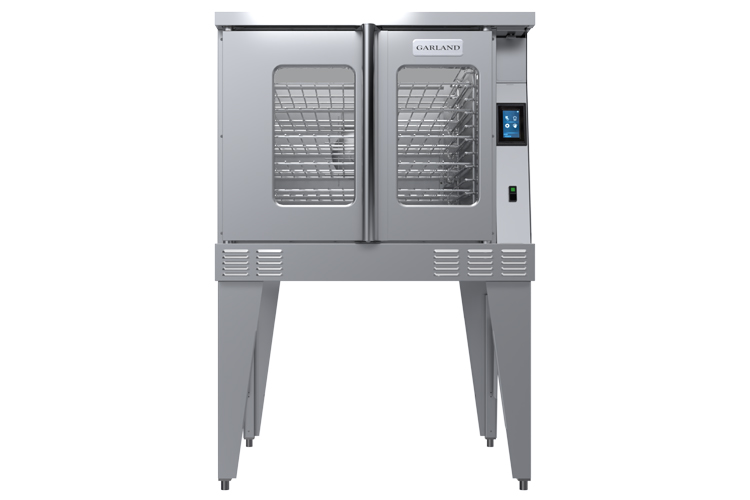
Garland: convection done well, and kept simple. Garland’s Master Series convection ovens focus on dry-heat cooking and baking, with controls almost anyone can learn. According to Garland:
- More room per deck: a 24″ high cooking chamber, which Garland says is 4″ taller than other convection ovens on the market, with 6 racks and a 13-position rack guide.
- Two depths: a standard 24″ cavity or a deep 29″ bakery-depth cavity that fits standard sheet pans in both directions.
- Gas or electric, single or double deck. Gas models are rated at 60,000 BTU (80,000 BTU upgrade at no additional charge); electric models are 10.4 kW per cavity. The cooking range is 150°F to 500°F.
- Two control options: simple analog controls with a mechanical timer and two fan speeds, or easyTouch digital control with press-and-go programming and Cook-n-Hold, which cooks and then automatically holds at a warming temperature.
- 60/40 split doors that Garland says are easy to open and close, even with one hand.
See the full lineup on Garland’s convection ovens page.
Questions to answer before you choose
The right oven starts with your operation, not the feature list. Before you order:
- Map the menu. List what you cook every day. If most of it is baking, roasting and sheet-pan items, convection may cover it. If you also steam vegetables, cook proteins that dry out easily, or hold and rethermalize, a combi can earn its keep.
- Check the utilities. A combi needs water and a drain, and water quality matters, so ask about filtration. For either oven, confirm the gas or electrical service at the install location.
- Measure the space and the hood. Confirm footprint, door swing and clearances. If hood space is limited, ask about ventless-listed combi models and what your local code requires.
- Be honest about labor. Who will run it, and how much training time do you have? Programmed recipes on either oven help a changing crew get consistent results.
- Consider both. Many kitchens are best served by a combi for the jobs only a combi can do and a convection oven for high-volume baking.
Segment notes
- K-12: Convection ovens are a familiar workhorse for sheet-pan baking and batch items. For districts moving toward scratch cooking, a combi adds steaming, roasting and rethermalizing with programmed recipes.
- Healthcare and senior living: Humidity control and rethermalization can help protect texture and moisture, which matters for patients and residents.
- Restaurants: A combi can bring steaming, roasting and reheating into one footprint. A convection oven is a straightforward choice when baking and roasting drive the menu.
- Bakery-cafés and C-stores: Garland’s deep-depth model fits sheet pans both directions, and Convotherm offers a maxx pro BAKE model aimed at baked goods and snacks.
E-Source Miller’s take
We don’t see combi vs. convection as a contest. A Garland convection oven is a dependable, easy-to-learn tool for operations that mostly bake and roast. A Convotherm combi makes sense when one oven needs to steam, roast, hold and reheat, and when consistency with a changing crew matters. The right answer comes from your menu, your space and your team, not from the spec sheet with the longest feature list.
That’s what Connect. Care. Change. looks like for us: the right equipment, matched to how your kitchen really runs.
Let’s find the right fit
Weighing a combi against a convection oven? Talk to your E-Source Miller rep. Bring your menu, your floor plan and your utility details, and we’ll help you compare capabilities, footprint and labor. Better yet, see them in action. At the E-Source Miller Culinary Center, 3680 W. Royal Lane, Suite 155, Irving, TX 75063, you can see and cook on both a Convotherm combi oven and a Garland convection oven side by side, with our culinary team there to walk you through what each one does best. Start at esourcemiller.com.
Recent Comments