
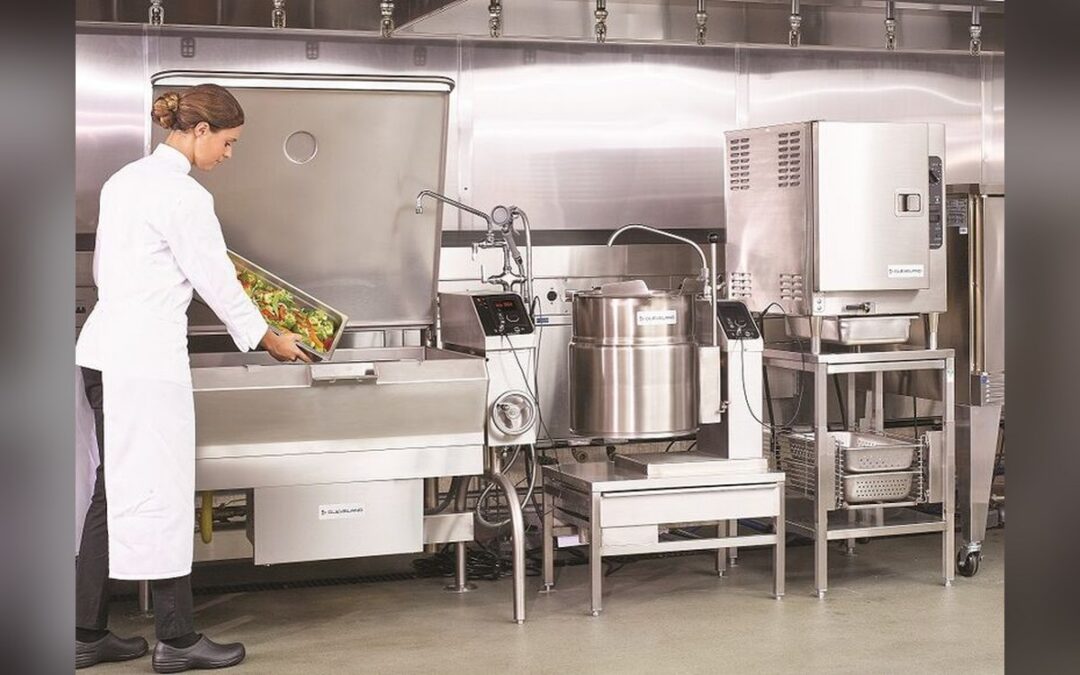

A steam-jacketed kettle or tilt skillet is one of the hardest-working pieces of equipment in a production kitchen. It is also one of the easiest to get wrong on paper. The capacity looks right, the footprint fits the floor plan, and the quote goes out. Then the unit arrives, and the lid swings open into the hood, or the rim sits higher than the people who use it every day can comfortably work.
The problem: it fits the floor plan, but does it fit the kitchen?
Capacity and floor space matter, but steam equipment lives in three dimensions. A kettle’s lid opens up and back. A skillet tilts forward to pour. And the crew works over the rim for hours at a time, stirring, scooping and cleaning.
When a spec only looks at gallons and footprint, the measurements that cause the most trouble, open-lid height and rim height, can get missed until install day.
Why it matters: install-day surprises are the expensive kind
Finding a fit problem after the unit is on site is about the worst time to find it. The options at that point are rarely good: rework the hood or the space around it, swap the unit for a different model, or live with equipment that is awkward and tiring to use every shift.
There’s a people cost, too: a rim that sits too high for your crew makes every batch harder.
How Cleveland’s Kettle & Skillet Selector helps
When we help with a steam package, we look at more than capacity and footprint. We look at the people running the equipment and the ceiling over it. That’s why we like the new Kettle & Skillet Selector from Cleveland Range, an online tool built around exactly those questions.
- The full lineup in one place: 37 steam-jacketed kettles and tilt skillets, from 30 to 80 gallons, across three heat sources.
- Filters that match how you plan: narrow the list by kettle or skillet; gas, electric or steam; stationary or tilting; and Short or Standard kettle series.
- Side-by-side comparison: compare up to four units, with capacity, rim height, open-lid height, footprint and list price lined up in one table.
- Drawn to scale: see each unit in side or top view, next to a 5′3″ woman, a 5′8″ man and a 36″ work-height line, so you can picture the crew at the equipment before you buy it.
Cleveland’s pro tip: check open-lid height against your hood and ceiling before you quote. It’s the measurement most likely to cause a surprise on install day, and the selector shows it for every model.
You can try it here: Cleveland Range Kettle & Skillet Selector.
A pre-quote checklist for kettles and tilt skillets
Before a kettle or skillet goes on a quote, walk through these:
- Open-lid height vs. hood and ceiling. Measure the real clearance at the install location, not the drawing.
- Rim height vs. your crew. Compare rim height to the 36″ work-height line and to the people who will actually run the unit.
- Footprint and workflow. For tilting units, picture where product pours and where pans or carts will sit while it does.
- Heat source vs. utilities. Confirm whether gas, electric or steam is available where the unit will go.
- Capacity vs. your menu. Size to your real batch volumes, not just the biggest pot that fits.
- Short vs. Standard series. If height is the issue, compare both kettle series before you change the plan.
Segment notes
- K-12: For districts doing more scratch cooking, kettles and skillets are workhorses. Crew height and ergonomics matter here, and the to-scale view helps you check them. Ask your E-Source Miller rep for current Cleveland promotions for school kitchens.
- Healthcare and senior living: For high-volume batch cooking in care kitchens, getting the size right the first time keeps projects on schedule. Ask your E-Source Miller rep for current Cleveland promotions for care kitchens.
- Restaurants and clubs: In tight back-of-house spaces, open-lid height under the hood is usually the deciding measurement.
E-Source Miller’s take
The best spec is the one that holds up on install day. We would rather catch a lid-height problem on a screen than on a loading dock, and a tool that draws every unit to scale, next to real people, makes that conversation a lot easier.
That’s what Connect. Care. Change. looks like in practice for us: connecting you with the right tool, taking the time to understand your space and your crew, and helping you find a better way to plan before anything ships.
Let’s spec it together
Planning a new kitchen or replacing a kettle or skillet? Talk to your E-Source Miller rep and bring your floor plan, hood dimensions and menu. We’ll work through the selector with you. You can also see and test steam equipment at our Culinary Center, 3680 W. Royal Lane, Suite 155, Irving, TX 75063. Start at esourcemiller.com.
Recent Comments